
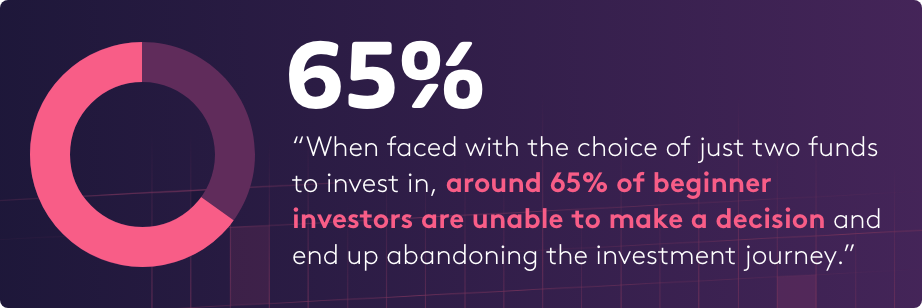
When faced with the choice of just two funds to invest in, around 65% of beginner investors are unable to make a decision and end up abandoning the investment journey.
That was one of the findings shared at a recent Seccl pensions roundtable, which brought together people from Zopa, OakNorth Bank, Visa, L&G, Prosper, Raindrop, Coutts and ClearBank.
It’s a striking statistic. Two funds is hardly an overwhelming amount of choice, yet almost two thirds of beginner investors still walked away. It’s a useful reminder that having more choice doesn’t necessarily make financial decisions easier – and can in fact make them harder. Confidence is the real blocker, particularly when people reach the point of deciding what to do with their retirement savings.
For years, much of the pensions industry’s attention has been focused on accumulation: encouraging people to save more, consolidate their pensions and engage with what they have. Much less attention has been paid to what happens at the other end, when people actually need to start taking their money out…
Drawdown is becoming harder to ignore
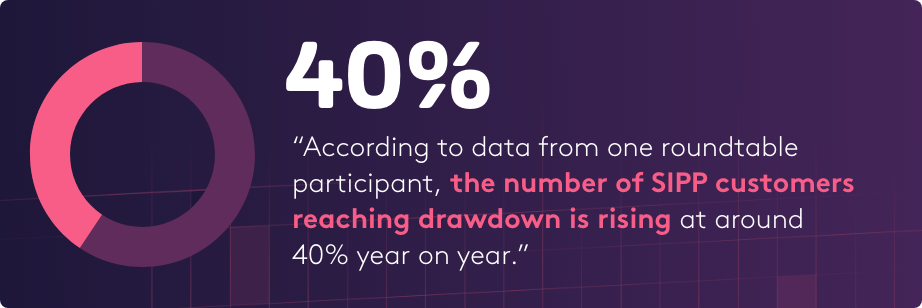
Only around one in eight self-invested personal pension (SIPP) customers are currently at the drawdown stage – that is, the point at which they start taking money from their pension. But according to one of the pensions experts at our roundtable, that number is rising quickly, at around 40% year on year, with much of that growth coming through non-advised platforms.
The experience those customers encounter can vary enormously. Some providers only pay out once a month, which can leave someone waiting several weeks if they make a request just after the cut-off. Newer infrastructure can support much faster payments, making the mechanics of accessing pension money look and feel more like the digital financial experiences people have become used to elsewhere.
But it’s not just a question of speed – drawdown journeys can be long and confusing, with people being asked to make a series of significant decisions about money that may need to last them for the rest of their lives. How much should they take? How often? What are the tax implications? What happens to the rest of the pot? How might one decision affect the income available later?
If choosing between two funds is enough to stop a beginner investor in their tracks, what hope do they have of navigating drawdown without advice?
There’s a huge need for better tools and calculators that can walk people through different options, show them the potential outcomes and explain why each step is being taken. That isn’t something the industry has really cracked yet – and it can’t be solved by faster infrastructure alone.
Money out, not money in
The last decade of pension and fintech innovation has brought huge improvements in consolidation, transfers, digital access and the visibility people have over their savings.
Pensions dashboards should take that further. By bringing together state, workplace and personal pensions in one place, and showing consumers their estimated retirement income (ERI), they could give millions of people a much more tangible sense of what their retirement might actually look like. As Seccl’s head of technical Chris Smeaton wrote recently, ERI could become one of the most powerful numbers in UK pensions.
But dashboards are still largely about helping people understand what they have accumulated. At some point, people have to work out what to do with the money they’ve spent decades saving – and that carries far more variables, uncertainty and emotional weight than putting £200 a month into a pension.
The confidence problem
Money feels like it should be impersonal and logical, but in reality it’s extremely emotional.
Moving around money that is meant to fund your future can elicit strong feelings – fear, vulnerability, anxiety – particularly for people who have spent years paying into workplace pensions without engaging closely with how those pensions are invested.
Many people stick with default funds precisely because someone else has made the decision for them. Drawdown removes some of that comfort. Suddenly there are choices to make and the consequences can feel much more immediate – and permanent.
That’s also where the conversation around targeted support becomes interesting.
We now expect almost every digital experience to be personalised to us. Targeted support could go some way towards providing more relevant financial help by grouping people according to shared characteristics, without moving into personalised financial advice.
But several people around the table questioned how far that model can really go in drawdown.
Retirement decisions can be highly individual. The right course of action can depend on someone’s wider assets, income needs, tax position, family circumstances, health, attitude to risk and plans for later life. The more consequential the decision becomes, the harder it is to support someone through a generic journey.
All of which leaves the industry with an awkward challenge: drawdown may be one of the areas where people need the most support, while also being one of the hardest places to provide it without advice.
People should be able to understand the options available to them, model different outcomes and see, in plain English, why they’re being asked each question. The process shouldn’t require someone to click through 25 screens without really understanding what any of the decisions mean.
Building a better drawdown experience
There was also discussion around where those experiences should live. Private dashboards could allow pension information and retirement tools to sit within the banking or personal finance apps people already use, rather than forcing them into an unfamiliar environment at precisely the point when the decisions become more complicated.
That creates an interesting opportunity for fintechs and other financial services firms. Better retirement experiences don’t necessarily have to begin with the pension provider itself – they could increasingly be built into the products people already use to understand and manage the rest of their financial lives.
Better infrastructure is part of that – with the faster and more flexible journeys it makes possible. But just as important (and arguably far harder) is making those journeys understandable.
The pensions industry has spent years making it easier to save, consolidate and transfer. As more people reach retirement through non-advised platforms, the next challenge is to make drawdown work better too, helping people to understand their options and use the money they’ve spent decades building up.