For years, pensions have felt disconnected from everyday financial life. Partly because they’re long-term by nature – money set aside for decades – and partly because of how they’ve been delivered: traditional providers, employer-chosen schemes, default funds, paper-heavy manual processes and long timelines.
The result is something out of step with how people want to manage their money today.
But that’s all changing.
As investing begins to surface within familiar brands, expectations are shifting. The fintechs are showing what good looks like. Bringing those embedded, digital-first experiences to pensions (arguably the stickiest money in financial services) is the next fintech frontier.
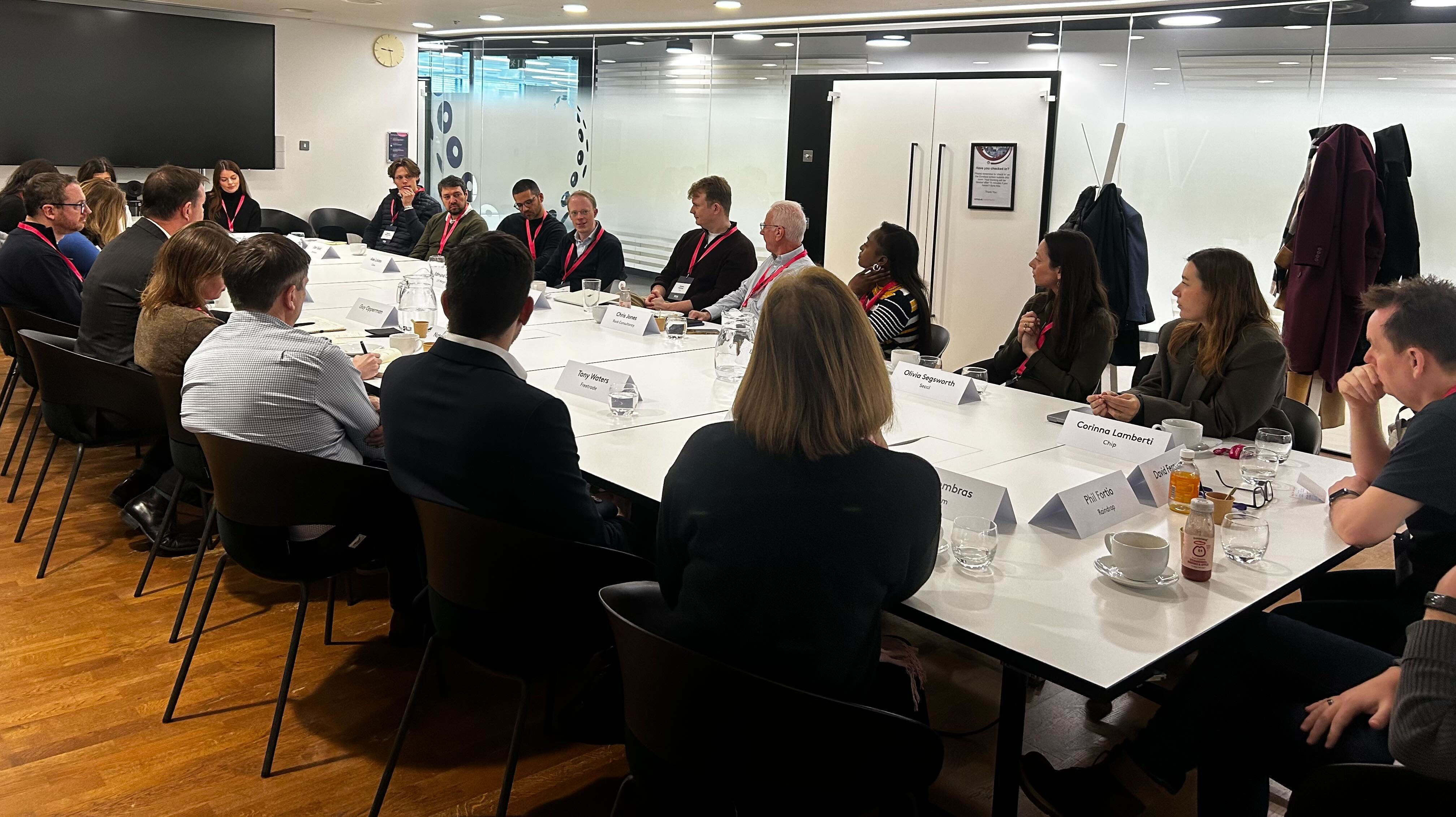
Chaired by Guy Opperman, former Minister for Pensions and Financial Inclusion, and Rock Consultancy’s Chris Jones, our recent roundtable brought together thought leaders from the likes of Chip, Blackrock, Zopa, Raindrop, Clove, JP Morgan and Tide. Together, we explored how the market is evolving, where the friction still lies, and what that means for the fintechs building the next generation of pension experiences.
The pensions landscape
We started with a collective overview of a pensions landscape that’s evolving against a backdrop of government policy, industry consolidation and structural change. Not through a single reform or breakthrough, but through a series of shifts that have been building over time and are now starting to align.
Workplace pensions and auto-enrolment have been a success. More people are saving, and over time those pension pots are becoming large enough to feel meaningful. For many savers, pensions are no longer an abstract future benefit but a material part of their overall financial picture.
Visibility was a recurring theme. As initiatives like the Pensions Dashboard move closer to launch, and as pensions begin to appear within clearer digital experiences, people are getting a better view of what they have – often for the first time. And, as these pensions come into focus, many are realising that workplace schemes alone may not deliver the outcomes they expect.
And this, it was noted, is where attitudes start to shift. Greater awareness is driving a growing sense of ownership – a recognition that individuals need to take control of and responsibility for their own pension savings.
At the same time, changes in working lives are contributing to a more fragmented pension picture. Less linear careers and more frequent job changes mean many people build up multiple pension pots over time. And, for a growing number of people – particularly those in self-employment or entrepreneurship – the idea of a traditional workplace pension is becoming redundant altogether. For this group, saving for retirement means making an active choice.
But as the discussion moved on, it became clear that while awareness and intent are growing, the practical reality of consolidating and moving pensions is still far from straightforward.
Legacy friction is real
The room was frank about the barriers that remain. Much of the friction in pensions is rooted in decades-old technology and processes that were never built for portability or frequent change. Legacy systems, manual workflows, and operational conservatism all play a role – alongside commercial structures that haven’t prioritised movement.
Inertia came up repeatedly. Default fund selection still dominates, and employer decisions about workplace pensions are often made once and left unreviewed for years. Historically, those decisions have focused on cost rather than outcomes. While the joint DWP and FCA Value-for-Money initiative promises to shift attention towards net performance, some participants were sceptical that this alone will drive meaningful change without further pressure.
This raised broader questions about choice and flexibility. Should all schemes be required to support partial transfers? How can the industry make it easier for individuals to move accumulated savings into a personal pension if they want more control? And how far should policy and regulation go in accelerating improvements?
These questions set the scene for the next part of the discussion: the transfer experience itself, where meaningful improvements have been made, but where there’s more still to be done.
Transfers are improving – but opacity can still undermine trust
There was clear optimism in the room about transfer times. Compared with even a few years ago, participants agreed that there’s been real progress. Transfers that once took months can now be measured in days, particularly for straightforward cases.
Some expressed the view that people will tolerate some waiting if the process is clear, predictable and works first time. What undermines trust most is opacity: submitting details, waiting days or weeks, then discovering something has failed; fixing one issue only to hit another; not knowing why something was rejected or where the process has stalled. Real-time progress updates – it’s been rejected, here’s why – were described as a meaningful shift in experience, and something that simply didn’t exist in pensions until recently.
There was also broad agreement that not all transfers should be treated equally. Most are straightforward and should move quickly. Genuinely complex cases need different timelines and processes. Splitting the market by complexity, rather than applying one-size-fits-all approach, was seen as a practical way forward.
Clearer service standards and statutory response times were viewed as an important baseline for trust across the industry.
With the right technology in place, participants felt the transfer experience can still materially improve – by making the journey more transparent, consistent and far less error-prone.
Engagement happens when life changes
A consistent view around the table was that pensions need to be useful in context, not isolation. Engagement works best when it’s linked to real, immediate life events – not framed solely around the distant idea of retirement.
Changing jobs or getting promoted is often the first moment people actively reassess where their pension sits and how much they’re contributing. Marriage brings pensions into focus through the need for joint planning. ‘Mid-life MOT’ moments prompt people to reassess health, wealth and long-term security. For younger customers, saving for a house deposit is often still the main financial goal.
The common thread here is intent. People are already making decisions, already reassessing priorities, already open to change. That’s when pension behaviour can shift.
Open banking-style experiences, embedded journeys, and clear visibility across finances all help here – making pensions feel less separate and more connected to everyday decision-making. Enabling contributions to flex between longer-term retirement savings and shorter-term goals like a house deposit was seen as a powerful way to build relevance - and, in turn, loyalty.
The takeaway was simple: engagement isn’t driven by annual reviews or one-off nudges. It’s driven by life. With digital-first products embedded in everyday money management, fintechs are well placed to meet customers at those moments and help them act with confidence.
Drawdown: the next experience gap – and opportunity
While there’s a lot of focus on accumulation, participants agreed that drawdown – especially within legacy setups – still lags behind the digital, intuitive experiences we’re starting to see earlier in the pension journey.
Participants pointed to drawdown processes that take weeks to set up, restrict payments to fixed dates, or require offline steps.
There was broad agreement that different customers have different expectations. Older customers may be more tolerant of longer timelines, particularly where certainty and reassurance are high. Younger customers, by contrast, will increasingly expect drawdown to feel digital and responsive – but still want confidence, clarity and, at times, human support when making significant decisions.
The opportunity, then, isn’t about same-day drawdown as a headline feature. It’s about building experiences that feel coherent and trustworthy across the full pension lifecycle. That means clear journeys, better education at the moment it matters, predictable access to income, and a consistent experience from accumulation through to decumulation.
An industry at an inflection point
The roundtable closed where it began: with optimism.
Auto-enrolment pots are getting bigger. Consumers are more digitally literate. Pensions are surfacing within trusted, familiar brands. Infrastructure is improving, and policy initiatives are creating momentum across the market.
For the first time in a long time, power is beginning to shift toward the individual.
For fintechs willing to lean in, pensions represent some of the stickiest money in financial services, and a long-term opportunity to build trusted, enduring relationships in a market that is finally starting to move.